
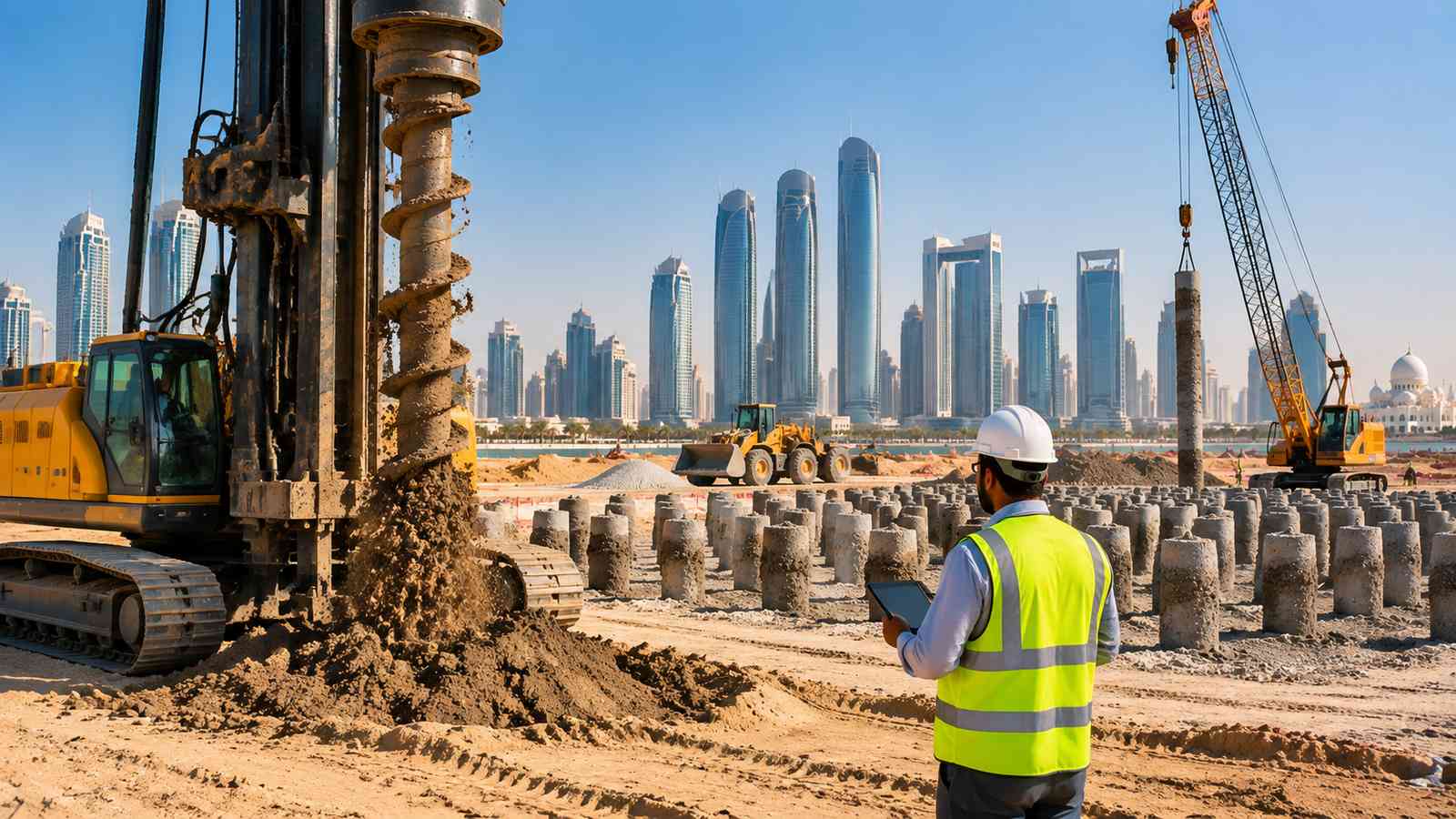
Before starting any major construction project, engineers must understand whether the existing ground conditions are suitable for the proposed structure. In many cases, natural soil may not have enough strength, stability, or load-bearing capacity to support construction without additional treatment.
This is where ground improvement techniques in UAE become an important part of modern construction. Ground improvement involves modifying existing soil conditions to increase strength, reduce settlement, improve stability, and create a safer foundation environment.
From high-rise buildings and industrial facilities to roads, bridges, and infrastructure developments, effective soil improvement solutions help engineers overcome challenging ground conditions and achieve reliable long-term performance.
What Is Ground Improvement?
Ground improvement is a collection of engineering methods used to enhance the properties of existing soil before construction begins.
The purpose is to improve important soil characteristics such as:
- Soil strength
- Bearing capacity
- Settlement behaviour
- Stability
- Drainage characteristics
- Compaction and density
Instead of completely removing and replacing weak soil, engineers can often improve the existing ground using specialised techniques that are more practical and cost-effective.
A proper geotechnical investigation in UAE helps engineers determine whether ground improvement is required and which technique is most suitable for the site.
Why Is Ground Improvement Important in UAE Construction?
The UAE has experienced rapid urban development, resulting in construction projects across different types of ground conditions.
Some sites may contain:
- Loose sandy soils
- Weak compressible layers
- Marine deposits
- Reclaimed land
- High groundwater conditions
- Variable soil profiles
These conditions can create challenges during foundation design and construction.
Without proper soil assessment and improvement where required, projects may experience:
- Excessive settlement
- Foundation movement
- Reduced bearing capacity
- Construction delays
- Higher project costs
Ground improvement provides engineers with a solution to enhance soil performance and prepare the site for safe construction.
Common Ground Improvement Techniques Used in UAE
The appropriate ground improvement method depends on several factors, including soil type, groundwater conditions, project requirements, and expected structural loads.
Below are some of the commonly used ground improvement methods in UAE construction projects.
1. Soil Compaction
Soil compaction is one of the simplest and most widely used ground improvement techniques.
The process increases soil density by reducing air voids within the soil structure.
Improved compaction helps increase:
- Soil strength
- Load-bearing capacity
- Settlement resistance
- Overall ground stability
Compaction is commonly used for:
- Road construction
- Building platforms
- Engineered fill
- Earthworks
- Site preparation
2. Dynamic Compaction
Dynamic compaction is a technique where heavy weights are repeatedly dropped onto the ground surface to improve soil density.
The impact energy travels through the soil, reducing void spaces and improving ground strength.
This method is commonly considered for:
- Large development sites
- Reclaimed land
- Loose granular soils
- Industrial projects
The effectiveness of dynamic compaction depends on soil conditions and requires proper engineering evaluation.
3. Vibro Compaction
Vibro compaction is a ground improvement method mainly used for loose granular soils such as sand.
The technique uses specialised vibrating equipment to rearrange soil particles and increase density.
Benefits include:
- Improved soil density
- Higher bearing capacity
- Reduced settlement potential
- Improved foundation conditions
This method is particularly relevant for projects built on sandy ground conditions.
4. Soil Stabilization
Soil stabilization involves improving soil properties by adding stabilising materials or modifying soil characteristics.
Depending on project requirements, stabilisation may involve:
- Cement stabilization
- Lime stabilization
- Chemical treatment
- Other engineering additives
Soil stabilization can improve:
- Strength
- Durability
- Resistance to moisture changes
- Construction performance
5. Grouting
Grouting involves injecting specialised materials into the ground to improve soil properties or fill voids.
It can be used for:
- Increasing soil strength
- Reducing permeability
- Filling underground voids
- Supporting existing structures
Different grouting techniques are selected depending on soil conditions and project objectives.
6. Stone Columns
Stone columns are vertical columns of compacted stone installed within weak soil to improve ground performance.
They help:
- Increase bearing capacity
- Reduce settlement
- Improve drainage
- Enhance soil stability
Stone columns are commonly used for buildings, industrial facilities, and infrastructure projects where weak soils require improvement.
7. Preloading and Soil Consolidation
Preloading involves applying additional temporary loads to the ground before construction.
This allows weak soils to consolidate and reduce future settlement.
The method is commonly considered for:
- Large developments
- Embankments
- Road projects
- Reclaimed areas
8. Geosynthetic Reinforcement
Geosynthetic materials can be installed within soil structures to improve stability and performance.
They are commonly used for:
- Roads
- Retaining structures
- Embankments
- Foundation support
How Engineers Select the Right Ground Improvement Method
There is no single ground improvement solution suitable for every project.
Engineers consider several factors before selecting a technique, including:
- Soil type
- Groundwater conditions
- Project size
- Structural loads
- Settlement requirements
- Construction timeline
- Cost considerations
A detailed soil investigation in UAE provides the information needed to select the most effective improvement method.
Role of Soil Testing Before Ground Improvement
Before applying any ground improvement technique, engineers need accurate information about existing soil conditions.
Soil testing helps determine:
- Current soil strength
- Soil classification
- Settlement behaviour
- Groundwater conditions
- Suitable improvement requirements
Professional soil testing services in UAE help engineers develop solutions based on actual site conditions rather than assumptions.
Benefits of Ground Improvement in Construction Projects
Effective ground improvement provides several advantages:
- Improved foundation performance
- Reduced settlement risks
- Enhanced soil stability
- Better construction efficiency
- Reduced long-term maintenance issues
- Greater flexibility in foundation design
Ground Improvement Challenges in UAE
Although ground improvement provides effective solutions, proper planning is essential.
Engineers must carefully consider:
- Local soil conditions
- Environmental factors
- Groundwater levels
- Construction limitations
- Required improvement performance
Incorrect selection of a technique can result in ineffective improvement or unnecessary costs.
Ground Improvement Services by Basalt Laboratories
Basalt Laboratories provides professional geotechnical investigation, soil testing, and engineering solutions across UAE.
Our services help clients understand ground conditions and develop suitable solutions for challenging construction sites.
Our capabilities include:
- Geotechnical investigations
- Soil testing
- Advanced testing solutions
- Engineering analysis
- Construction recommendations
By combining accurate investigation with engineering expertise, Basalt Laboratories helps developers, contractors, and consultants make informed decisions before construction begins.
Frequently Asked Questions
What is ground improvement in construction?
Ground improvement is the process of modifying existing soil conditions to increase strength, improve stability, reduce settlement, and prepare the ground for construction.
Why is ground improvement required in UAE projects?
Ground improvement may be required when existing soil conditions do not provide sufficient strength or stability for the planned structure.
Which ground improvement technique is commonly used in UAE?
The suitable technique depends on soil conditions and project requirements. Common methods include soil compaction, vibro compaction, soil stabilization, grouting, and stone columns.
How is the correct ground improvement method selected?
Engineers select the appropriate method after evaluating soil conditions, groundwater levels, structural requirements, and project objectives through geotechnical investigation.
Can ground improvement reduce construction costs?
Yes. Proper ground improvement can help avoid excessive excavation, unnecessary foundation systems, and future settlement problems, improving overall project efficiency.
Conclusion
Ground conditions play a major role in the success of any construction project. When natural soil does not provide the required performance, ground improvement techniques offer effective solutions to create safer and more stable foundations.
From soil compaction and stabilization to advanced techniques such as vibro compaction and grouting, the right approach depends on detailed investigation and engineering evaluation.
With professional ground improvement solutions in UAE, developers and contractors can overcome challenging soil conditions and build with greater confidence.
Contact Basalt Laboratories for reliable geotechnical investigation, soil testing, and engineering support for your next construction project in UAE.