<p>
Choosing the right <strong>independent soil testing laboratories LLC Abu Dhabi</strong> is an important decision for any construction project. Before a building, road, industrial facility, or infrastructure project can be designed properly, engineers need reliable information about the soil and ground conditions beneath the site.
</p>
<p>
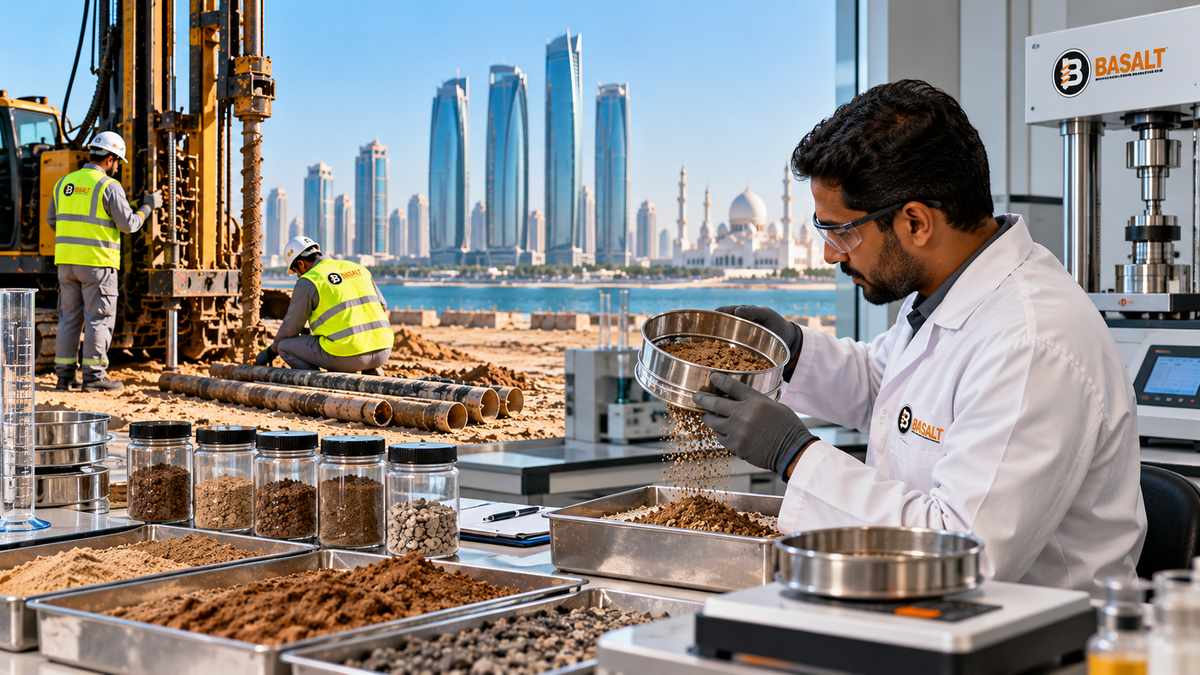
A professional soil testing laboratory does much more than analyse a sample. The right testing partner can support the project through field investigation, soil sampling, laboratory testing, interpretation of results, and preparation of technical information for engineers and consultants.
</p>
<p>
In Abu Dhabi, where construction takes place across a variety of ground conditions, having accurate and project-specific soil data can help developers, contractors, and consultants make better decisions about foundations, earthworks, settlement, groundwater, and construction methods.
</p>
<h2>What Are Independent Soil Testing Laboratories?</h2>
<p>
An independent soil testing laboratory provides testing and technical assessment of soil and other construction-related materials without being responsible for constructing the project itself. This separation can be valuable when reliable test data is needed for design verification, quality control, compliance, or construction decision-making.
</p>
<p>
For a construction project, the laboratory may receive samples collected during a geotechnical investigation and perform the tests required to understand their physical, mechanical, and chemical properties.
</p>
<p>
The important point is that laboratory testing should be connected to the actual engineering requirements of the project. Ordering a large number of tests is not necessarily better if those tests do not answer the questions the design team needs to resolve.
</p>
<h2>Why Is Soil Testing Important for Construction in Abu Dhabi?</h2>
<p>
The conditions below a construction site cannot always be understood by looking at the surface. Soil characteristics can change with depth and from one part of a site to another.
</p>
<p>
Depending on the location and development, engineers may need to consider:
</p>
<ul>
<li>Different soil layers</li>
<li>Loose or dense granular materials</li>
<li>Weak or compressible layers</li>
<li>Groundwater conditions</li>
<li>Existing fill</li>
<li>Rock or weathered material</li>
<li>Soil chemical characteristics</li>
</ul>
<p>
These conditions can influence foundation selection, settlement assessment, excavation planning, earthworks, and other parts of the construction process.
</p>
<p>
This is why professional <strong>soil testing in Abu Dhabi</strong> should be treated as an engineering input rather than simply a laboratory requirement.
</p>
<h2>What Services Should a Soil Testing Laboratory Provide?</h2>
<p>
The exact services required depend on the project, but a capable <strong>soil testing laboratory in Abu Dhabi</strong> may support several stages of a construction investigation.
</p>
<h3>Soil Sampling and Testing</h3>
<p>
Soil samples collected during field investigation can be examined in the laboratory to determine relevant engineering properties.
</p>
<p>
Depending on the project, testing may include:
</p>
<ul>
<li>Particle size distribution</li>
<li>Moisture content</li>
<li>Atterberg limits</li>
<li>Density testing</li>
<li>Direct shear testing</li>
<li>Consolidation testing</li>
<li>Permeability testing</li>
<li>Triaxial testing</li>
<li>Unconfined compression testing</li>
<li>Chemical testing</li>
</ul>
<p>
Not every project requires all of these tests. The laboratory testing programme should be selected according to the ground conditions and engineering requirements.
</p>
<h2>Field Investigation and Laboratory Testing Work Together</h2>
<p>
It is important to understand the difference between field investigation and laboratory testing.
</p>
<p>
Field investigation helps establish what is present beneath the site. Boreholes, trial pits, SPT, CPT, sampling, and other investigation methods provide information about the subsurface profile.
</p>
<p>
Laboratory testing then provides additional information about selected soil, rock, or water samples.
</p>
<p>
The two should not be viewed as separate activities. A useful geotechnical assessment comes from considering field observations, test results, groundwater information, and engineering requirements together.
</p>
<h2>Common Soil Tests Used in UAE Construction Projects</h2>
<h3>Standard Penetration Test (SPT)</h3>
<p>
The <strong>Standard Penetration Test</strong> is commonly performed during borehole investigations. It provides an indication of soil resistance at different depths and can help engineers understand changes in subsurface conditions.
</p>
<p>
SPT results are normally interpreted together with borehole descriptions, groundwater observations, laboratory results, and other project information rather than being used as a standalone foundation recommendation.
</p>
<h3>Cone Penetration Test (CPT)</h3>
<p>
The <strong>Cone Penetration Test</strong> provides continuous measurements as an instrumented cone is pushed into suitable ground. This can give engineers detailed information about changes in soil behaviour with depth.
</p>
<p>
CPT can be particularly useful when a project requires detailed subsurface profiling or additional information for foundation-related assessments.
</p>
<h3>Soil Classification Testing</h3>
<p>
Soil classification tests help identify the characteristics and composition of soil. Particle size distribution, moisture content, and Atterberg limits can all contribute to understanding how a soil material behaves.
</p>
<h3>Compaction Testing</h3>
<p>
Compaction testing is important for projects involving engineered fill, earthworks, roads, platforms, and other areas where the density and moisture condition of placed soil need to be controlled.
</p>
<h3>CBR Testing</h3>
<p>
The <strong>California Bearing Ratio (CBR)</strong> test is commonly associated with pavement and road design. It provides information about the strength characteristics of soil or subgrade material under specified testing conditions.
</p>
<h2>Why Groundwater Matters in Abu Dhabi Soil Investigation</h2>
<p>
Groundwater can have an important influence on construction, particularly when a project involves basements, deep excavations, underground structures, or foundations extending below the groundwater level.
</p>
<p>
A geotechnical investigation may include groundwater observations and, where appropriate, additional assessment of groundwater characteristics.
</p>
<p>
Understanding groundwater conditions can help the project team plan for issues such as:
</p>
<ul>
<li>Excavation</li>
<li>Dewatering</li>
<li>Basement construction</li>
<li>Foundation installation</li>
<li>Long-term durability considerations</li>
</ul>
<p>
Groundwater observations should always be interpreted in relation to when and how they were measured because groundwater levels can change.
</p>
<h2>What Should You Look for in an Independent Soil Testing Laboratory?</h2>
<p>
When comparing <strong>soil testing laboratories in Abu Dhabi</strong>, price should not be the only consideration. The quality and usefulness of the information provided can have a much greater impact on the project.
</p>
<h3>1. Experienced Technical Team</h3>
<p>
Look for a laboratory with qualified engineers, geologists, laboratory technicians, and field personnel who understand how test results are used in real construction projects.
</p>
<h3>2. In-House Laboratory Capability</h3>
<p>
Having laboratory testing capabilities available within the organisation can make coordination between field investigation, sample handling, testing, and reporting more efficient.
</p>
<h3>3. Field Investigation Capability</h3>
<p>
For projects requiring a complete geotechnical investigation, it is useful to work with a provider that can coordinate field investigation as well as laboratory testing.
</p>
<h3>4. Appropriate Testing Methods</h3>
<p>
A professional laboratory should be able to recommend testing based on the actual requirements of the project rather than automatically applying the same package to every site.
</p>
<h3>5. Clear Technical Reporting</h3>
<p>
Test results are only useful when the project team can understand them. Reports should clearly present the relevant results and provide information that can be used by engineers and consultants.
</p>
<h3>6. Experience With UAE Projects</h3>
<p>
Local experience is valuable because construction projects across Abu Dhabi and the wider UAE can encounter different soil, groundwater, geological, and site conditions.
</p>
<h2>Why Choosing the Right Laboratory Can Save Time and Money</h2>
<p>
It can be tempting to choose a testing provider simply because its quotation is the lowest. However, the cheapest investigation is not always the most economical option for the overall project.
</p>
<p>
Incomplete investigation or unsuitable testing can create uncertainty later in the project and may contribute to:
</p>
<ul>
<li>Additional investigation</li>
<li>Design revisions</li>
<li>Unexpected ground-related problems</li>
<li>Construction delays</li>
<li>Additional testing costs</li>
<li>Unplanned ground improvement or excavation work</li>
</ul>
<p>
A properly planned testing programme gives the project team useful information early, when there is still time to make informed design and construction decisions.
</p>
<h2>Independent Soil Testing for Different Construction Projects</h2>
<p>
The scope of soil testing depends heavily on what is being built.
</p>
<h3>Residential and Villa Projects</h3>
<p>
Residential developments may require investigation of soil strength, foundation conditions, settlement, groundwater, and other factors relevant to the proposed structure.
</p>
<h3>Commercial Buildings</h3>
<p>
Commercial buildings can involve larger footprints, greater structural loads, basements, and more complex foundation requirements. These factors can increase the need for detailed geotechnical information.
</p>
<h3>Industrial Projects</h3>
<p>
Industrial facilities may include warehouses, factories, heavy equipment, large floor slabs, and concentrated loads. Soil testing can help engineers evaluate the ground conditions relevant to these requirements.
</p>
<h3>Road and Infrastructure Projects</h3>
<p>
Infrastructure projects often require testing of subgrade and other materials to support pavement, earthworks, and civil engineering design.
</p>
<h2>From Soil Samples to Engineering Decisions</h2>
<p>
One of the most important things to understand about laboratory testing is that a test result is not the final engineering decision.
</p>
<p>
For example, a laboratory may determine a particular soil property under a defined testing condition. The geotechnical engineer then considers that result alongside the soil profile, field investigation, groundwater conditions, structural loads, and project requirements.
</p>
<p>
This process turns individual test results into information that can support foundation and construction decisions.
</p>
<h2>Basalt Laboratories: Soil Testing and Geotechnical Services in Abu Dhabi</h2>
<p>
<a href="https://basaltlab.com/">Basalt Laboratories</a> has been operating from Abu Dhabi since 2016 and provides engineering and consulting services to industrial, commercial, governmental, and private clients across the UAE.
</p>
<p>
The company provides geotechnical investigation and laboratory testing services, supported by professional engineers, geologists, field and laboratory technicians, and licensed drilling rig operators.
</p>
<p>
Basalt's services include <a href="https://basaltlab.com/geotechnical-investigations/">geotechnical investigation</a>, <a href="https://basaltlab.com/material-soil-testing/">material and soil testing</a>, advanced testing, pile testing, non-destructive testing, geophysical investigation, and geotechnical design.
</p>
<p>
The laboratory's soil testing capabilities include a range of physical, mechanical, and chemical tests used to support civil engineering and construction projects.
</p>
<p>
For a construction project in Abu Dhabi, the appropriate testing scope should be based on the proposed development, site conditions, expected loads, foundation concept, and requirements of the project's engineering team.
</p>
<h2>Questions to Ask Before Hiring a Soil Testing Laboratory</h2>
<p>
Before appointing a laboratory, it is worth asking a few practical questions:
</p>
<ul>
<li>What type of investigation does my project require?</li>
<li>Which field tests will be performed?</li>
<li>Which laboratory tests are recommended and why?</li>
<li>How many samples will be tested?</li>
<li>Will groundwater conditions be investigated?</li>
<li>Who will review and interpret the results?</li>
<li>What will be included in the final report?</li>
<li>Does the company have experience with similar UAE projects?</li>
</ul>
<p>
These questions can help you compare laboratories based on the quality and relevance of their service rather than price alone.
</p>
<h2>Frequently Asked Questions</h2>
<h3>What is an independent soil testing laboratory?</h3>
<p>
An independent soil testing laboratory provides testing and technical assessment of soil and related construction materials separately from the construction work itself. This can provide project teams with objective testing information for design, quality control, and construction decisions.
</p>
<h3>Why is soil testing important in Abu Dhabi?</h3>
<p>
Soil conditions can vary between sites and with depth. Soil testing and geotechnical investigation provide information about ground strength, soil characteristics, groundwater, settlement-related considerations, and other factors that may influence construction.
</p>
<h3>What tests are commonly performed on soil?</h3>
<p>
Depending on the project, testing may include particle size analysis, moisture content, Atterberg limits, compaction, CBR, direct shear, consolidation, permeability, triaxial testing, chemical analysis, and other specialised tests.
</p>
<h3>Is SPT enough for a complete soil investigation?</h3>
<p>
SPT can provide valuable field information, but it is not automatically sufficient for every project. The investigation scope should be determined according to the structure, site conditions, foundation requirements, and engineering objectives.
</p>
<h3>What is the difference between soil testing and geotechnical investigation?</h3>
<p>
Soil testing refers to individual field or laboratory tests performed on soil, while a geotechnical investigation is the broader process of studying subsurface conditions through field investigation, sampling, testing, groundwater assessment, and engineering interpretation.
</p>
<h3>How do I choose a soil testing laboratory in Abu Dhabi?</h3>
<p>
Consider the laboratory's technical experience, testing capabilities, field investigation services, reporting quality, equipment, laboratory facilities, and experience with UAE construction projects. Price should be considered together with the scope and quality of the proposed service.
</p>
<h3>Does every construction project require the same soil tests?</h3>
<p>
No. Testing requirements vary according to the project type, site conditions, foundation system, expected loads, groundwater, and engineering requirements. A suitable testing programme should be developed for the specific project.
</p>
<h2>Conclusion</h2>
<p>
Choosing the right <strong>independent soil testing laboratories LLC Abu Dhabi</strong> is about more than finding a laboratory that can produce test results. The right partner should understand the project, select appropriate investigation and testing methods, maintain reliable laboratory procedures, and provide information that engineers can actually use.
</p>
<p>
For construction projects in Abu Dhabi and across the UAE, proper soil investigation can help reduce uncertainty before foundation and earthwork decisions are finalised.
</p>
<p>
Whether you are developing a villa, commercial building, industrial facility, road, or major infrastructure project, reliable ground information is an important part of responsible construction planning.
</p>
<p>
<strong>Basalt Laboratories provides soil testing, geotechnical investigation, laboratory analysis, and engineering support for construction projects across Abu Dhabi and the UAE.</strong>
</p>
<p>
<a href="https://basaltlab.com/contact/">Contact Basalt Laboratories</a> to discuss your project and determine the appropriate soil testing and geotechnical investigation requirements.
</p>