
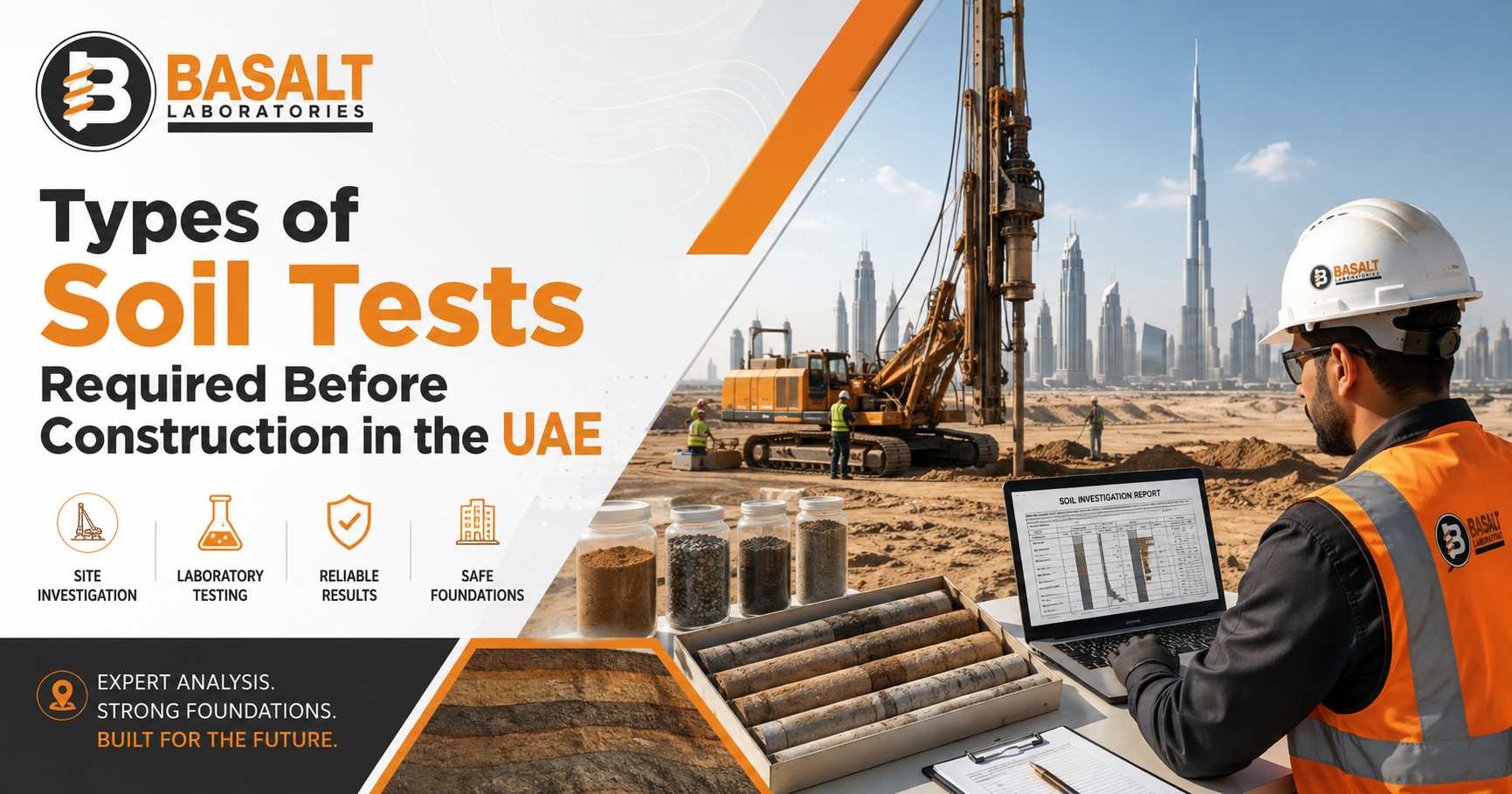
Before any building rises above the ground, engineers need to understand what lies underneath it.
A plot may look perfectly stable from the surface, but below it there can be loose sand, weak fill, compressible layers, shallow groundwater, cavities, aggressive salts, or rock at unexpected depths. Any of these conditions can influence the type, depth, safety, and cost of a foundation.
That is why soil testing before construction in the UAE is such an important part of project planning.
From villas and warehouses to high-rise buildings, roads, industrial facilities, and major infrastructure projects, geotechnical information helps engineers determine whether the ground can safely support the proposed development and what measures may be required before construction begins.
However, there is no single soil test that provides every answer. A proper geotechnical investigation in the UAE normally combines field investigation, sampling, laboratory testing, groundwater observations, and engineering interpretation.
The exact tests selected depend on the structure, expected loads, site geology, groundwater conditions, project requirements, and recommendations of the engineering consultant.
Why Is Soil Testing Important Before Construction?
The foundation transfers the weight of a building into the ground. If engineers do not have reliable information about that ground, foundation design may be based on assumptions rather than actual site conditions.
Insufficient investigation can contribute to problems such as:
- Excessive or uneven settlement
- Foundation movement
- Cracking in structural or architectural elements
- Unexpected problems during excavation
- Groundwater entering excavations
- Problems with retaining structures or temporary works
- Unnecessary use of expensive foundation systems
- Construction delays caused by unexpected ground conditions
- Additional ground improvement or dewatering costs
Professional soil testing in the UAE is therefore more than a procedural requirement. It provides engineers with data that can affect the safety, constructability, durability, and overall cost of a project.
In some cases, a detailed investigation can also help reduce construction costs. Reliable ground information allows engineers to select a foundation solution based on actual conditions instead of unnecessary assumptions.
Soil Testing vs Geotechnical Investigation: What Is the Difference?
The terms soil testing and geotechnical investigation are often used interchangeably, but they do not mean exactly the same thing.
A soil test is an individual test performed either in the field or on a soil sample in a laboratory. Examples include moisture content testing, sieve analysis, CBR testing, and direct shear testing.
A geotechnical investigation, on the other hand, is the complete process of studying the ground beneath a proposed development.
A typical geotechnical investigation may include:
- Reviewing the proposed development and available site information
- Planning borehole or investigation locations
- Drilling boreholes or excavating trial pits
- Conducting in-situ soil tests
- Collecting disturbed and undisturbed samples
- Performing laboratory soil testing
- Recording groundwater conditions
- Interpreting field and laboratory results
- Developing geotechnical design parameters
- Preparing recommendations in a geotechnical report
The individual soil tests therefore form part of the wider geotechnical investigation.
Types of Soil Tests Required Before Construction in the UAE
Not every construction project requires every soil test listed below. The testing programme should be selected according to the proposed structure, ground conditions, site characteristics, and engineering requirements.
The following are among the most commonly used soil tests before construction in the UAE.
1. Standard Penetration Test (SPT)
The Standard Penetration Test, or SPT, is one of the most commonly used in-situ geotechnical tests.
SPT is normally performed inside a borehole. During testing, a standard sampler is driven into the soil using a controlled hammering procedure. The number of blows required to achieve a specified amount of penetration is recorded as the SPT resistance or N-value.
What Does an SPT Test Tell Engineers?
SPT results can help engineers evaluate:
- Relative density of granular soils
- Consistency of certain cohesive soils
- Changes in soil strength with depth
- Different subsurface layers
- Foundation design conditions
- Settlement considerations
- Geotechnical design parameters
One major advantage of an SPT test in the UAE is that measurements can be taken at different depths during borehole drilling.
A site may contain dense material near the surface but weaker material several metres below. Without sufficient investigation depth, these weaker layers could be missed.
2. Cone Penetration Test (CPT)
The Cone Penetration Test, commonly known as CPT, is another advanced method used to investigate subsurface soil conditions.
During CPT testing, an instrumented cone is pushed continuously into the ground while sensors measure resistance.
Typical CPT measurements may include:
- Cone tip resistance
- Sleeve friction
- Additional parameters depending on the testing equipment
Why Is CPT Testing Useful?
CPT data can assist engineers with:
- Identifying soil layers
- Assessing soil behaviour
- Evaluating relative density
- Estimating geotechnical design parameters
- Assessing foundation conditions
- Supporting pile design
- Identifying changes in subsurface conditions
Because CPT provides nearly continuous information with depth, it can provide a detailed picture of the ground profile.
Depending on the project and geology, CPT may be used alongside boreholes and laboratory testing rather than as a complete replacement for them.
3. Particle Size Distribution or Sieve Analysis
One of the most fundamental laboratory soil tests is particle size distribution, commonly performed using sieve analysis for coarse-grained soils.
Soil contains particles of different sizes, including gravel, sand, silt, and clay. Determining the proportion of different particle sizes helps engineers classify the soil and understand its likely engineering behaviour.
Why Does Soil Gradation Matter?
Particle size distribution can influence:
- Drainage characteristics
- Permeability
- Compaction
- Density
- Shear behaviour
- Suitability as construction fill
- Pavement performance
Particle size analysis is therefore a common part of laboratory soil testing in the UAE.
4. Moisture Content Test
A moisture content test determines the amount of water present within a soil sample.
Although it is a relatively straightforward laboratory test, moisture can significantly affect soil behaviour.
Changes in moisture content may influence:
- Compaction
- Soil strength
- Compressibility
- Workability
- Consistency of fine-grained soils
For earthworks and fill materials, understanding moisture conditions is especially important because soil may need to be conditioned before achieving the required level of compaction.
5. Atterberg Limits
For fine-grained soils, engineers may perform Atterberg Limit tests.
These tests determine how the consistency of soil changes as its moisture content changes.
The main parameters include:
- Liquid Limit
- Plastic Limit
- Plasticity Index
Why Are Atterberg Limits Important?
Atterberg Limits help engineers classify fine-grained soil and understand how sensitive it may be to changes in moisture.
The results can assist with the assessment of:
- Soil classification
- Workability
- Volume change
- Moisture sensitivity
- Earthworks performance
- Foundation conditions
Atterberg Limit results should normally be interpreted together with other laboratory and field test results.
6. Proctor Compaction Test
Where a project involves engineered fill, road subgrades, platforms, backfilling, or earthworks, soil compaction testing becomes particularly important.
A laboratory compaction test, commonly associated with Proctor testing, establishes the relationship between soil moisture content and dry density.
The results generally identify:
- Maximum Dry Density
- Optimum Moisture Content
Why Does Soil Compaction Matter?
Poorly compacted soil or fill can settle after construction.
This may contribute to:
- Pavement depressions
- Slab settlement
- Movement around utilities
- Uneven external areas
- Premature pavement defects
Laboratory compaction results are frequently used alongside field density testing during construction.
7. California Bearing Ratio (CBR) Test
The California Bearing Ratio, or CBR test, is particularly important for road, pavement, and infrastructure projects.
The test evaluates the load-bearing performance of soil or subgrade material and helps pavement engineers determine suitable pavement and sub-base requirements.
CBR Testing Is Commonly Used For:
- Road construction
- Parking areas
- Industrial yards
- Access roads
- Infrastructure projects
- Pavement design
- Subgrade assessment
A low CBR value may indicate that existing soil requires improvement, replacement, stabilisation, or a modified pavement design.
8. Direct Shear Test
The direct shear test evaluates the shear strength characteristics of soil.
Shear strength is important because soil must resist forces that could cause one part of the soil mass to move relative to another.
Direct shear test results may be used for engineering analysis involving:
- Foundations
- Retaining structures
- Slopes
- Excavations
- Embankments
- Earthworks
Depending on the soil and testing conditions, engineers may obtain parameters such as cohesion and the angle of internal friction.
9. Triaxial Test
A triaxial soil test provides detailed information about soil strength under controlled stress conditions.
Different test arrangements may be selected depending on the engineering problem, including:
- Unconsolidated Undrained (UU)
- Consolidated Undrained (CU)
- Consolidated Drained (CD)
Triaxial testing can provide useful parameters for:
- Foundation design
- Slope stability analysis
- Excavation design
- Embankments
- Retaining structures
- Geotechnical stability assessments
The appropriate type of triaxial test should be selected according to the soil conditions and how the ground is expected to behave during and after construction.
10. Consolidation Test
Certain soils compress gradually when additional loads are applied.
A soil consolidation test helps engineers evaluate this behaviour.
The results can provide information about:
- Soil compressibility
- Settlement characteristics
- Rate of consolidation
Settlement assessment is particularly important where compressible soil layers are present.
Foundation design is not only about determining whether the ground can support a structure without immediate failure. Engineers must also consider how much the soil may deform over time.
Excessive total or differential settlement can damage a structure even when conventional bearing-capacity failure has not occurred.
11. Unconfined Compression Test
An Unconfined Compression Test may be carried out on appropriate cohesive soil or rock samples.
For suitable cohesive soils, the test provides information about compressive strength and can assist engineers in assessing material consistency and behaviour.
For rock samples, unconfined compressive strength can also provide important information about the strength of intact rock material.
The test is not suitable for every type of soil, so its use depends on the materials encountered during the investigation.
12. Permeability Testing
Soil permeability describes how easily water can flow through the ground.
This information can be particularly important for projects involving:
- Basements
- Deep excavations
- Dewatering
- Retaining structures
- Drainage systems
- Earth structures
- Groundwater-sensitive construction
Common laboratory methods may include falling-head or constant-head permeability testing depending on the type of soil.
A highly permeable sand layer can create very different construction challenges compared with a low-permeability fine-grained layer.
Understanding permeability before excavation begins can therefore help engineers plan appropriate groundwater-control and dewatering measures.
13. Groundwater Testing and Chemical Analysis
Groundwater is another important consideration during a geotechnical investigation in the UAE.
Groundwater conditions can affect both construction activities and the long-term durability of buried structural elements.
Water samples may be analysed for parameters such as:
- pH
- Chloride content
- Sulphate content
- Total Dissolved Solids (TDS)
Chemical conditions may influence material specifications for concrete, steel, and other construction elements in contact with the ground.
A shallow groundwater level can also affect:
- Excavation works
- Basement construction
- Dewatering requirements
- Temporary works
- Foundation installation
- Buoyancy considerations
Groundwater conditions can vary significantly between locations, which makes site-specific investigation essential.
14. Chemical Testing of Soil
Soil samples can also be subjected to chemical testing.
Depending on project requirements, testing may include:
- Chloride content
- Sulphate content
- pH
- Other relevant chemical parameters
Chemical soil testing helps engineers understand whether the surrounding ground may create an aggressive environment for concrete, steel, foundations, or buried infrastructure.
The results can influence durability requirements and material specifications.
15. Soil Thermal Resistivity Testing
Not every soil investigation is associated with a conventional building.
For projects involving underground electrical cables and power infrastructure, the thermal characteristics of surrounding soil can be extremely important.
Soil thermal resistivity testing evaluates how effectively the ground can dissipate heat.
If surrounding soil cannot transfer heat effectively, underground cables may operate at higher temperatures, potentially affecting performance and service life.
Thermal resistivity testing may therefore be relevant for:
- Power transmission projects
- Underground cable routes
- Utility infrastructure
- Substations
- Industrial developments
What About a Soil Bearing Capacity Test?
Soil bearing capacity test is a commonly searched term, but it is important to understand what bearing capacity means from an engineering perspective.
There is not always one single laboratory test that provides the final allowable bearing pressure for a building.
Instead, a geotechnical engineer may determine appropriate bearing conditions by considering several sources of information, including:
- Borehole records
- SPT results
- CPT data
- Soil classification
- Laboratory strength testing
- Groundwater conditions
- Foundation dimensions
- Foundation depth
- Structural loads
- Settlement calculations
The final recommendation is therefore based on engineering interpretation of the complete ground investigation rather than a number obtained from one isolated test.
Are All Soil Tests Required for Every UAE Construction Project?
No. Not every project needs every test.
A villa, industrial warehouse, high-rise building, road, and underground utility project will have very different geotechnical requirements.
The scope of testing can depend on factors such as:
- Type and size of development
- Building height
- Structural loads
- Proposed foundation system
- Basement depth
- Site area
- Existing fill
- Local geology
- Groundwater conditions
- Adjacent buildings and structures
- Previous site development
- Engineering consultant requirements
- Relevant authority requirements
A professional geotechnical engineer should therefore develop the investigation programme according to the actual project rather than simply ordering every available soil test.
Typical Soil Investigation Process Before Construction
Although every site is different, a typical soil investigation in the UAE generally follows several key stages.
Step 1: Review the Proposed Project
The geotechnical team reviews information including:
- Site location
- Proposed development
- Number of floors
- Basement requirements
- Expected structural loads
- Available drawings
- Existing geotechnical information
Step 2: Plan the Investigation
The investigation team determines suitable:
- Borehole locations
- Investigation depths
- Sampling intervals
- In-situ testing methods
- Laboratory testing requirements
- Specialist investigation methods
Step 3: Obtain Necessary Approvals
Required site permits, access arrangements, utility clearances, safety procedures, and applicable authority requirements should be addressed before intrusive field investigation begins.
Step 4: Carry Out the Field Investigation
Field investigation may include:
- Borehole drilling
- Trial pits
- SPT testing
- CPT testing
- Soil and rock sampling
- Groundwater observations
- Geophysical investigation where required
Step 5: Laboratory Soil Testing
Selected samples are transferred to a soil testing laboratory for testing according to the engineering requirements of the project.
Step 6: Engineering Interpretation
Field observations and laboratory test results are evaluated together.
A laboratory result becomes most useful when it is interpreted within the context of the proposed structure, subsurface profile, groundwater conditions, and expected loading.
Step 7: Prepare the Geotechnical Report
A geotechnical report may provide information and recommendations relating to:
- Soil and rock profile
- Groundwater conditions
- Foundation options
- Allowable bearing pressure
- Settlement
- Foundation depth
- Pile design parameters where relevant
- Excavation requirements
- Shoring considerations
- Dewatering
- Earthworks
- Ground improvement
- Fill and compaction requirements
- Chemical aggressiveness
- Additional investigation where required
When Should Soil Testing Be Done?
Ideally, soil testing should be completed before the structural foundation design is finalised.
Waiting until excavation or construction has already started can create unnecessary engineering and financial risks.
If unexpected weak soil or groundwater conditions are discovered late, the project may require:
- Foundation redesign
- Additional excavation
- Ground improvement
- Dewatering
- Piling
- Programme changes
- Additional construction costs
Early geotechnical investigation gives the design team more options and allows foundation recommendations to become part of the original design rather than a problem that must be solved later.
How Deep Should Soil Testing Go?
There is no single investigation depth suitable for every construction project.
The required depth depends on factors such as:
- Foundation type
- Foundation dimensions
- Building loads
- Number of storeys
- Depth of weak soil layers
- Soil and rock profile
- Proposed piles
- Basement excavation
- Local geological conditions
A small villa may require a different investigation depth compared with a high-rise development, industrial structure, or heavily loaded infrastructure project.
The investigation should extend deep enough to identify the soil and rock conditions that could influence the proposed development.
How to Choose a Soil Testing Laboratory in the UAE
Price and turnaround time are important, but they should not be the only factors considered when choosing a soil testing laboratory in the UAE.
Technical Capability
The company should have suitable equipment, experienced personnel, and the testing capabilities required for the specific project.
Qualified Geotechnical Personnel
Laboratory numbers alone do not provide the complete answer. Results need to be interpreted by experienced professionals who understand their implications for design and construction.
Field and Laboratory Capabilities
Working with a provider capable of coordinating both field investigation and laboratory testing can improve continuity between drilling, sampling, testing, and engineering interpretation.
Recognised Testing Standards
Testing should be carried out according to appropriate recognised standards and relevant project specifications.
Clear Geotechnical Reporting
A professional report should do more than present laboratory values. It should clearly explain what the findings mean for the proposed development.
Experience With UAE Ground Conditions
Experience with regional geology, groundwater conditions, construction practices, and project requirements can help make the investigation more efficient and relevant.
Soil Testing Is More Than a Construction Requirement
It is easy to think of geotechnical investigation as simply another task that must be completed before construction starts.
In reality, it is one of the earliest opportunities to reduce uncertainty in a project.
The ground is one of the few major elements of a construction project that cannot simply be manufactured according to a specification. Engineers have to work with the conditions that already exist beneath the site.
The better those conditions are understood, the better informed the foundation and construction decisions can be.
A properly planned programme of soil testing in the UAE can help identify risks early, support safe foundation design, reduce unexpected construction problems, and provide engineers with reliable parameters for their calculations.
Soil Testing and Geotechnical Investigation With Basalt Laboratories
Basalt Laboratories provides professional geotechnical investigation, soil testing, material testing, advanced field testing, and geotechnical engineering services in the UAE.
Our services cover different stages of understanding subsurface conditions, including site investigation, borehole drilling, in-situ testing, laboratory analysis, and geotechnical reporting.
Rather than applying the same testing package to every development, an appropriate investigation should be planned around the proposed structure, expected loads, site conditions, and engineering requirements.
Whether you are planning a villa, commercial building, industrial facility, infrastructure development, road, or other construction project, understanding the ground before construction begins can significantly reduce uncertainty later.
For assistance with soil testing or geotechnical investigation, contact Basalt Laboratories and provide your project location, development details, and available drawings so the technical team can assess an appropriate investigation scope.
Frequently Asked Questions About Soil Testing in the UAE
What soil tests are required before building construction in the UAE?
The exact tests depend on the proposed development and site conditions. A typical investigation may include borehole drilling, SPT testing, soil classification, particle size analysis, moisture content, Atterberg Limits, and selected strength, consolidation, permeability, or chemical tests. Larger or more complex projects may require CPT or other advanced investigation methods.
Is soil testing required before constructing a villa in the UAE?
Geotechnical information is commonly needed to support foundation design for new developments, including villas. However, the exact investigation and approval requirements depend on the project location, design, consultant requirements, and relevant authority.
What is an SPT soil test?
SPT stands for Standard Penetration Test. It is normally performed inside a borehole and measures soil resistance to penetration using a standardised testing procedure. The results help engineers understand subsurface conditions at different depths.
What is the difference between SPT and CPT?
SPT is typically carried out at selected intervals within a borehole. CPT involves continuously pushing an instrumented cone through suitable ground while recording resistance. The methods provide different types of geotechnical information and can complement each other.
What is a CBR soil test used for?
The California Bearing Ratio test evaluates the load-bearing characteristics of soil or subgrade material and is commonly used for road and pavement design.
How long does soil testing take in the UAE?
The required time depends on the number and depth of boreholes, site accessibility, approvals, laboratory testing requirements, and complexity of the investigation. A reliable schedule should be established after reviewing the project-specific scope.
How much does soil testing cost in the UAE?
There is no single standard cost for every project. The price depends on factors such as drilling depth, number of boreholes, site conditions, required field tests, laboratory testing programme, access requirements, and reporting scope.
Can construction begin before receiving the geotechnical report?
Foundation and excavation decisions should be based on suitable engineering information and the requirements of the project's consultants and relevant authorities. Completing the geotechnical investigation early helps avoid starting construction based on assumed ground conditions.
What does a geotechnical report contain?
Depending on the project scope, a geotechnical report may include borehole logs, soil and rock descriptions, laboratory and field test results, groundwater observations, engineering parameters, foundation recommendations, settlement considerations, and guidance related to excavation, shoring, piling, earthworks, or ground improvement.
Where can I get soil testing in Abu Dhabi?
Basalt Laboratories provides soil testing and geotechnical investigation services in Abu Dhabi and across the UAE, supporting building, infrastructure, industrial, commercial, and engineering projects.
Conclusion
No two construction sites are exactly alike. Even neighbouring plots can contain different soil layers, groundwater conditions, rock formations, or fill histories.
That is why reliable soil testing before construction in the UAE should be based on the actual site and proposed development rather than assumptions about what lies underground.
Tests such as SPT, CPT, sieve analysis, Atterberg Limits, compaction, CBR, direct shear, triaxial, consolidation, permeability, groundwater, and chemical testing each answer different engineering questions.
The real value comes from selecting the right tests, combining them into a properly planned geotechnical investigation, and interpreting the results in relation to the structure that will eventually stand above the ground.
Understanding the ground early gives developers, consultants, contractors, and engineers better information to build on.
Every successful foundation starts with understanding the ground beneath it.