
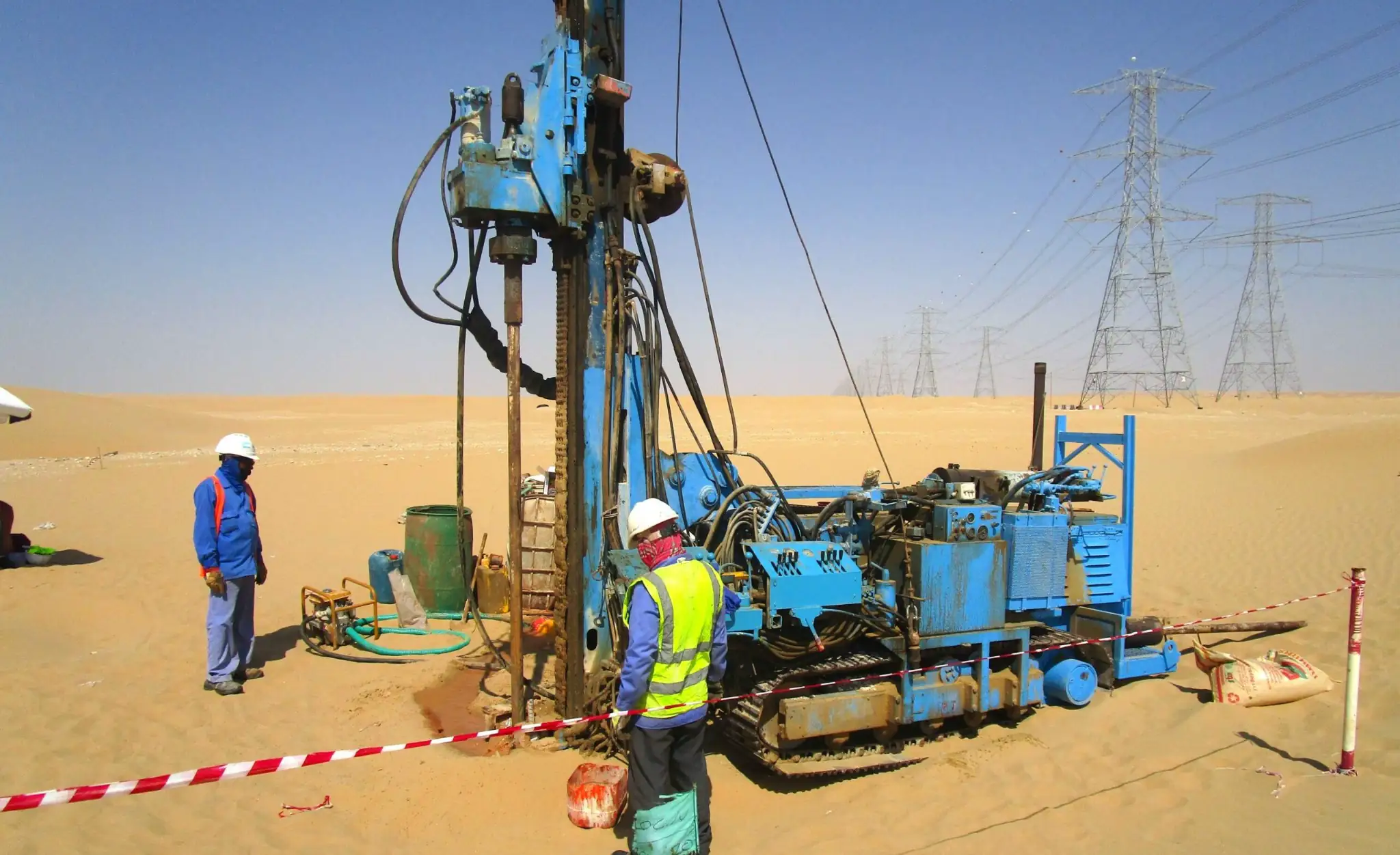
Before a building rises above ground, someone needs to understand what is happening below it. In Abu Dhabi, a geotechnical investigation is commonly required when the condition of the soil, rock or groundwater could influence a project's foundations, excavation, stability or approval requirements. This applies particularly to new buildings, piled foundations, basements, infrastructure works, major extensions and sites where the ground conditions are uncertain.
The exact requirement is not identical for every project. It depends on the proposed structure, its loads, the site location, the foundation concept and the conditions attached to the relevant permit. That is why the safest approach is to confirm the required scope with the project's engineering consultant and the relevant Abu Dhabi authority before design or site work begins.
What Is a Geotechnical Investigation?
A geotechnical investigation is a structured assessment of the ground beneath a proposed development. It combines fieldwork, soil or rock sampling, in situ testing, laboratory analysis and engineering interpretation. The objective is not simply to identify the type of soil. It is to understand how the ground is likely to behave once it carries a building, road, retaining wall, utility corridor or other structure.
A properly planned geotechnical investigation in Abu Dhabi helps the design team answer practical questions such as:
- 1. How much load can the ground safely support?
- 2. Is settlement likely to be within acceptable limits?
- 3. Would shallow foundations be suitable, or are piles needed?
- 4. Is groundwater likely to affect excavation or construction?
- 5. Will the site require ground improvement, dewatering or specialist shoring?
- 6. Are there weak layers, uncontrolled fill, cavities or other subsurface risks?
The resulting geotechnical report gives structural and civil engineers site-specific information for foundation design and construction planning.
When Is a Geotechnical Investigation Required in Abu Dhabi?
A ground investigation should be considered whenever the design depends on assumptions about subsurface conditions. In practice, it is most often required in the following situations.
1. New Buildings and Major Developments
New villas, residential buildings, commercial properties, warehouses, industrial facilities and public developments normally need reliable ground information before their foundations can be finalised. Even when neighbouring buildings already exist, their foundation solution should not automatically be copied. Ground conditions can vary across a relatively short distance, while the proposed building may impose very different loads.
For a small and straightforward project, the investigation may be limited in scope. A taller, heavier or more complex development may require deeper boreholes, more investigation points and a wider range of laboratory tests.
2. Projects Requiring Foundation Design
Foundation design depends on more than the weight of a structure. Engineers need to understand bearing capacity, settlement characteristics, groundwater conditions and the depth and strength of different soil or rock layers. Without this information, a foundation may be unnecessarily expensive or may not adequately address the actual ground risk.
A geotechnical report allows the designer to compare suitable options, which may include isolated footings, raft foundations, piles or ground-improvement solutions. The aim is a foundation that is safe and appropriate for the real site conditions not one based on guesswork.
3. Basements, Deep Excavations and Shoring Works
A basement or deep excavation changes the ground around it. The design team must consider soil stability, groundwater, excavation depth and the effect of the work on neighbouring roads, utilities and structures. A geotechnical investigation supports decisions about temporary support, permanent retaining systems, dewatering and construction sequencing.
This becomes especially important on constrained urban sites, where an excavation problem may affect more than the development itself.
4. Piled Foundations and Heavily Loaded Structures
Projects using piles need information about the soil and rock layers through which the piles will pass and the strata expected to carry the load. The investigation informs preliminary pile type, length and capacity recommendations. It also helps the project team plan appropriate verification, such as static or dynamic load testing and pile integrity testing.
Ground investigation and pile testing serve different purposes. The investigation supports the design, while pile testing checks the behaviour or integrity of the installed foundation system.
5. Roads, Utilities and Infrastructure Projects
Geotechnical work is not limited to buildings. Roads, bridges, pipelines, utility routes, embankments, drainage systems and flood-management infrastructure all interact with the ground. These projects may require assessment of subgrade strength, compaction, settlement, slope stability, permeability, groundwater or the suitability of material for reuse.
Because infrastructure often extends over a large area, the investigation must be planned to capture changes along the route rather than relying on a single test location.
6. Sites with Uncertain or Problematic Ground Conditions
An investigation becomes particularly important where the site may contain loose sand, variable fill, weak layers, shallow groundwater or evidence of previous excavation and backfilling. Coastal and reclaimed environments can also present conditions that require careful evaluation. These factors do not automatically make a site unsuitable, but they can change the appropriate foundation, excavation or ground-improvement strategy.
Warning signs may include unexpected cracking in nearby structures, localised settlement, water entering excavations or inconsistent ground encountered during early site work. If these appear, continuing without specialist assessment can make the eventual solution more complicated and expensive.
7. Extensions, Alterations or Increased Structural Loads
A geotechnical investigation may also be needed for an existing property when an extension is added, extra floors are proposed, the building use changes or new machinery creates significant loads. The original foundation may have been designed for a different structural arrangement, and an old soil report may not cover the part of the plot affected by the new work.
The project engineer should review the existing records, the proposed loads and the current site condition before deciding whether previous data is sufficient or new testing is required.
8. When Requested for a Permit or Technical Review
Abu Dhabi's municipal services include soil test permit requests and review of soil investigation reports. The authority or engineering reviewer may therefore require a defined investigation and report as part of the project approval process.
Abu Dhabi City Municipality's Safety Requirements for Soil Test Works state that the necessary authority approvals and permits must be obtained before soil testing activities begin. The circular also states that a geophysical study should be conducted before geotechnical investigation work where required by the soil test permit.
This is an important distinction: a geophysical survey is not something to add automatically to every project. Its need and scope should follow the permit requirements and the site-specific investigation plan.
What Does the Investigation Process Include?
The investigation should be designed around the proposed development rather than selected from a standard package. Although the scope varies, a typical process may include the following stages.
- Reviewing the project: The consultant examines the location, proposed structure, expected loads, site history and available records.
- Planning and permitting: Suitable investigation points, depths and testing methods are selected, and required approvals are obtained.
- Geophysical work where required: Non-intrusive methods may be used before drilling in accordance with the soil test permit or project needs.
- Field investigation: Boreholes, trial pits, sampling and in-situ tests are completed at appropriate locations and depths.
- Laboratory testing: Selected soil, rock or water samples are tested to establish relevant physical, mechanical and chemical properties.
- Engineering interpretation: Field and laboratory results are assessed together rather than reported as isolated numbers.
- Geotechnical reporting: The findings, design parameters, risks and practical recommendations are presented to the project team.
Depending on the site and structure, field testing may include Standard Penetration Tests (SPT), Cone Penetration Tests (CPT), groundwater observations or other specialist methods. Laboratory work may include particle-size analysis, moisture content, Atterberg limits, direct shear, consolidation, permeability, unconfined compression or triaxial testing.
What Should a Geotechnical Report Tell You?
A useful report should do more than list borehole logs and laboratory results. It should explain what the findings mean for the proposed project. Depending on the agreed scope, the report may address:
- The sequence and description of soil and rock layers
- Groundwater observations at the time of investigation
- Allowable bearing pressure and anticipated settlement
- Suitable foundation options and founding depths
- Preliminary pile-design parameters where relevant
- Excavation, temporary stability and shoring considerations
- The need for ground improvement or replacement of unsuitable material
- Earthworks, fill placement and compaction recommendations
- Potential chemical aggressiveness affecting buried concrete or steel
- Further investigation, monitoring or testing required during construction
The recommendations must always be read in the context of the proposed structure and the limitations stated in the report. If the design changes significantly, the geotechnical engineer should be asked to review whether the original investigation still covers the revised project.
When Should the Investigation Be Carried Out?
The best time is early enough to influence the design, but after the project team has enough information to define a sensible scope. Ideally, the investigation is completed before the structural engineer finalises the foundation system and before major excavation or piling work is planned.
Leaving soil testing until late in the programme can create avoidable redesign. For example, a foundation concept based on assumed ground conditions may need to change once actual soil or groundwater conditions are known. Early investigation gives the team more time to compare options and manage costs.
How to Choose a Geotechnical Investigation Company in Abu Dhabi
The quality of a ground investigation depends on both the fieldwork and the judgement used to interpret it. When selecting a provider, consider whether the company:
- Has relevant Abu Dhabi experience with similar ground conditions and project types
- Can develop a project-specific investigation scope
- Uses competent drilling crews, technicians, geologists and geotechnical engineers
- Maintains appropriate testing, calibration, quality and safety procedures
- Can provide clear factual results and practical engineering recommendations
- Understands applicable authority, permit and reporting requirements
- Can support the design and construction teams after the report is issued
Price matters, but the lowest quotation may not represent the best value if it excludes necessary investigation points, suitable depths, laboratory testing or engineering interpretation. The scope should be compared carefully before appointing a laboratory or consultant.
Frequently Asked Questions
Is a soil test required before building a villa in Abu Dhabi?
A soil investigation is commonly requested for new construction, including villas, because the foundation design needs reliable ground information. However, the exact scope and permit requirement depend on the plot, proposed design and relevant authority review. The appointed engineering consultant should confirm what is required for the specific project.
Is soil testing the same as a geotechnical investigation?
Not exactly. Soil testing normally refers to specific field or laboratory tests. A geotechnical investigation is broader: it includes planning, field exploration, testing, interpretation and recommendations for design and construction.
Can an old geotechnical report be reused?
Possibly, but it should never be assumed. The previous investigation may relate to a different building, load, foundation or part of the site. Ground conditions may also have been changed by excavation, filling or nearby work. A geotechnical engineer should review the old report and current project before it is relied upon.
Is a geophysical survey always required before borehole drilling?
No. Abu Dhabi City Municipality's circular links the requirement to the soil test permit. The project team should follow the conditions stated in the applicable permit and the investigation plan.
How long does a geotechnical investigation take?
The programme depends on permits, site access, the number and depth of boreholes, the required field and laboratory tests and the complexity of the engineering assessment. A reliable timescale can only be provided after the project scope and site conditions have been reviewed.
Plan the Ground Investigation Before Finalising the Foundation
A geotechnical investigation is required when a project needs verified information about the ground to support safe design, construction planning or authority approval. In Abu Dhabi, the correct scope should be based on the proposed development, site conditions and permit requirements, not a generic testing package.
Basalt Laboratories provides geotechnical investigation, soil and material testing, advanced field testing and geotechnical engineering support across Abu Dhabi and the UAE. To discuss the appropriate investigation for your development, contact our geotechnical team with the project location, proposed structure and available drawings.